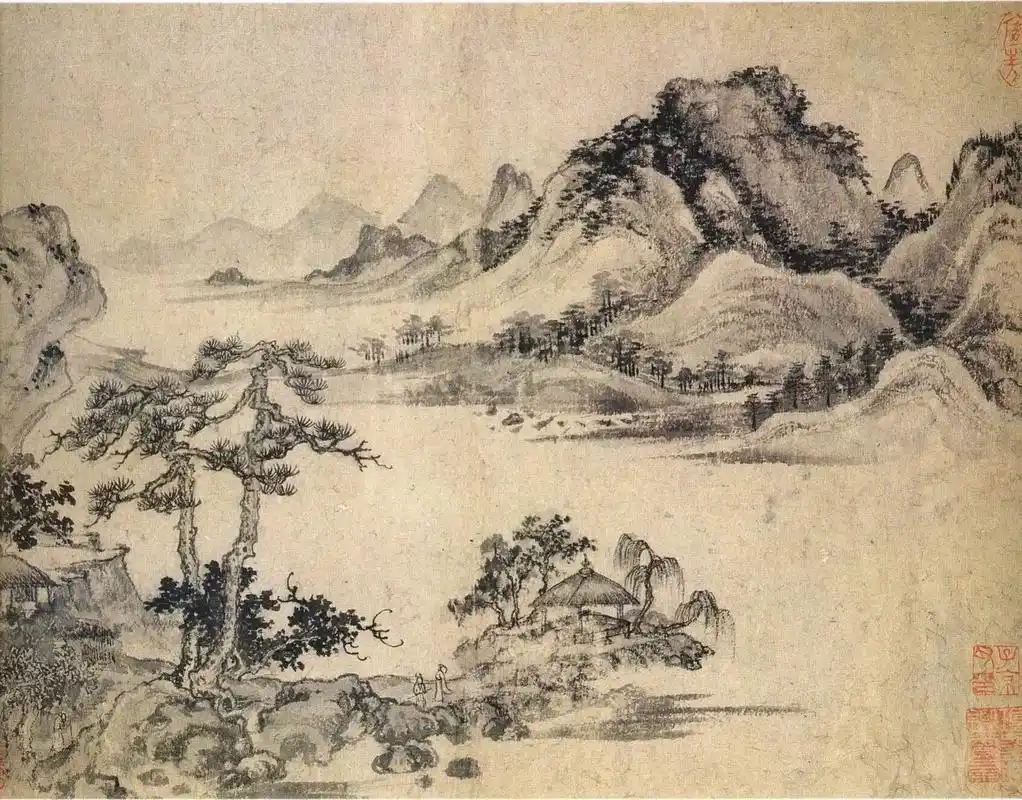
Wang Meng (painter)
Introduction
Wang Meng (1308-1385) is celebrated as one of the four great masters of the Yuan Dynasty, alongside Huang Gongwang, Wu Zhen, and Ni Zan. His work exemplifies the sophisticated literati style of landscape painting that emerged during this period. Known for his intricate brushwork and deeply emotive interpretations of natural scenes, Wang Meng's paintings reflect a unique synthesis of personal expression and traditional Chinese artistic principles. His contributions to Chinese art have left a lasting impact, influencing generations of painters and solidifying his place in the pantheon of great Chinese artists.
Early Life
Wang Meng was born into a family with deep artistic roots. He was the grandson of the renowned painter-calligrapher Zhao Mengfu, a prominent figure in the Yuan Dynasty court who played a significant role in the development of literati painting, a style characterized by its emphasis on personal expression over realistic representation. His upbringing in this artistic environment profoundly influenced his development as an artist, providing him with a rich foundation in both the technical and philosophical aspects of Chinese art.
Wang Meng's early exposure to the works of his grandfather and other prominent artists of the time, such as Huang Gongwang, profoundly shaped his artistic vision. The Yuan Dynasty was a period of great cultural and artistic achievement, and Wang Meng was well-placed to benefit from the flourishing artistic scene. He was introduced to the principles of literati painting, which emphasized the artist's emotional response to nature and the importance of individual interpretation. This tradition would become a hallmark of Wang Meng's work.
Artistic Career
Wang Meng's career as a painter spanned several decades, during which he developed a distinctive style that blended traditional elements with personal innovation. His landscapes are characterized by their complexity and the dense, textured brushwork that conveys the vitality and dynamism of the natural world. Unlike the more restrained and minimalist approaches of his contemporaries, Wang Meng's paintings are rich with detail and imbued with a sense of movement and energy.
Style and Influences
Wang Meng's artistic style is deeply rooted in the literati tradition, yet it also reflects his personal vision and emotional depth. His brushwork is renowned for its complexity and fluidity, capturing the essence of the landscapes he depicts. This style was heavily influenced by his grandfather Zhao Mengfu's innovative approach to composition and brush technique. Moreover, Wang Meng drew inspiration from the works of other great Yuan masters, such as Huang Gongwang, whose expressive use of ink and composition left a lasting impression on his work.
In his paintings, Wang Meng often explored themes of reclusion and introspection, reflecting the literati's ideal of retreating into nature as a means of achieving philosophical enlightenment. This is evident in his depictions of secluded mountains, winding rivers, and dense forests, which serve as metaphors for the artist's inner journey. His landscapes are not mere representations of physical locations but rather expressions of his spiritual engagement with the world around him.
Legacy and Impact
Wang Meng's contributions to Chinese art have had a lasting impact, influencing countless artists in the centuries that followed. His innovative techniques and unique interpretation of the literati style have been studied and emulated by generations of painters, both in China and beyond. Wang Meng's legacy is not only found in his paintings but also in his influence on the development of Chinese art theory and practice.
The enduring appeal of Wang Meng's work lies in its ability to transcend time and cultural boundaries, offering viewers a glimpse into the artist's world and the philosophical ideals that shaped his vision. His paintings continue to be celebrated for their technical mastery and emotional resonance, solidifying his place as one of the great masters of Chinese art history. Wang Meng's impact on the art world remains profound, as his work continues to inspire and challenge new generations of artists to explore the intersection of tradition and personal expression.








